Growing Up Guyanese in America: How Parents Are Raising Kids Who Actually Love Where They Come From
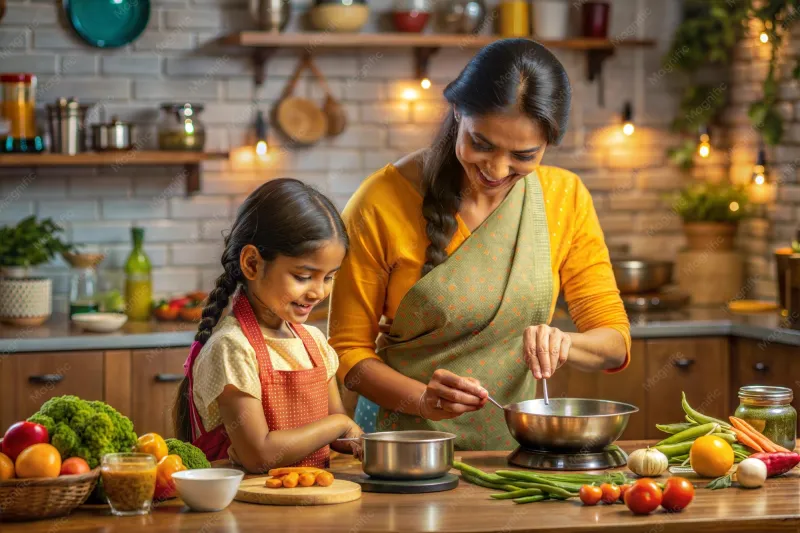
Photo: Guyanese family cooking together in kitchen mother and daughter, via img.freepik.com
Somewhere between soccer practice and TikTok, a generation of Guyanese American kids is growing up without ever having tasted fresh coconut water straight from the tree. Their parents know every road in Berbice by heart. Their kids can barely spell it.
For Guyanese families spread across New York, Florida, Toronto, and beyond, passing down culture to children who were born into a completely different world is one of the quiet, daily struggles nobody talks about enough. It doesn't make the evening news. But it keeps a lot of parents up at night.
So what actually works? We asked some of them — and more importantly, we asked their kids.
Start in the Kitchen, Not the Classroom
Ask any Guyanese parent what their first move was, and nine times out of ten, they'll point to food. Not a lesson plan. Not a heritage workbook. The stove.
Sharonda Persaud, a mom of three in the Bronx, says she started pulling her daughter into the kitchen around age seven. "I didn't make it a lecture," she says. "I just said, 'Come help me make dhal.' And she came. Every week, she came."
Now her daughter is fifteen and can knock out a full Sunday cook-up without supervision. More importantly, she wants to. She posts it on Instagram. Her friends think it's cool.
Food works because it bypasses the resistance. Kids who roll their eyes at a history lesson will happily eat their way into a culture. And once they know how something is made — once their hands have rolled out the roti dough — it belongs to them in a way that no amount of telling ever could.
The Visit Question
Here's where things get complicated. Most Guyanese parents will tell you that nothing compares to actually taking your kids home. Walking the seawall. Meeting the cousins. Eating a mango off the tree in somebody's yard. No documentary, no YouTube video, no amount of storytelling recreates that.
But trips to Guyana aren't cheap, especially if you're flying a family of four out of JFK. And timing matters too — take a kid at four years old and they won't remember much. Wait until they're sixteen and they're already deep in their American identity, possibly resentful about missing a summer with their friends.
Parents who've cracked this tend to aim for that sweet spot: somewhere between ages eight and twelve, when kids are old enough to actually absorb the experience but young enough to still be genuinely curious about where their family comes from.
Marcus Alleyne, who grew up in Georgetown before moving to Atlanta, took his son back at age nine. "I didn't hype it up too much beforehand," he says. "I just let it happen. And when he saw where I went to school, where I used to play cricket — he got quiet. You could see it landing."
That trip was four years ago. His son still brings it up.
What the Teenagers Actually Say
We talked to several Guyanese American teens, and their answers were more thoughtful than their parents expected.
Jada, seventeen, from Queens, says what connected her wasn't any one big thing. It was the accumulation of small things over years — her grandmother's voice on WhatsApp every Sunday, the way her mom lit up whenever a soca song came on, the framed map of Guyana on the living room wall that she used to trace with her finger as a little kid.
"It never felt forced," she says. "It just felt like that was part of our house."
Ryan, sixteen, from Miramar, Florida, had a different experience. His parents tried hard — too hard, he says. "Every weekend was like a culture lesson. I got burned out. It started feeling like homework."
He's honest about the fact that he's still figuring out how much of his Guyanese identity he actually wants to claim. But he also admits that when his uncle visited from Georgetown last year and they spent a whole afternoon just talking — not being taught, just talking — something shifted.
"My uncle didn't try to make me feel Guyanese," Ryan says. "He just treated me like I already was."
That's the distinction that keeps coming up. The parents who seem to have the most success aren't the ones drilling their kids on history or forcing Creole lessons on Saturday mornings. They're the ones who make Guyanese identity feel like a natural, living thing in the house — not a subject to pass.
Language: The Long Game
Creole is tricky. It's not a language you can sign your kid up to learn on Duolingo. It lives in households, in the rhythm of conversation, in the jokes that only make sense if you already know the context.
Some parents make a rule: Creole only at the dinner table. Others lean on grandparents to carry that load, letting the kids absorb it through phone calls and visits rather than structured lessons.
Hindi phrases, for Indo-Guyanese families, often come through religious spaces — mandir visits, pujas, the songs that get sung at family gatherings. Several parents mentioned that their kids picked up more cultural language through those rituals than through any deliberate effort.
The honest truth is that full fluency is probably not the goal for most second and third-generation kids. Connection is. Familiarity is. Knowing that when your grandmother says something in Creole, you understand the warmth behind it even if you can't fully translate it back.
Making It Cool Instead of Obligatory
One thing the most connected Guyanese American teens have in common? Their parents never made the culture feel like a burden.
That means celebrating the wins publicly — sharing Guyanese food with American friends, talking about Guyana in spaces where it might spark curiosity, letting kids see their parents proud rather than anxious about where they come from.
It also means being honest about the complicated parts. Guyana has a real history — of colonialism, of racial tension, of economic struggle. Parents who engage with that honestly, age-appropriately, tend to raise kids who see their heritage with clear eyes rather than a romanticized or shame-based lens.
"I told my daughter that Guyana is not perfect," says Sharonda from the Bronx. "But I also told her it made us. And that's worth knowing."
Her daughter nods when this is relayed to her. "She's right," she says. "I just needed her to say it like that instead of just telling me to be proud."
The Real Bottom Line
Raising kids who genuinely love where their family comes from isn't about perfect execution. It's not about the right curriculum or the most strategic trip itinerary. It's about showing up consistently — in the kitchen, in the stories you tell at the dinner table, in the way you talk about home when nobody's forcing you to.
Kids are watching. They notice what their parents care about. And if Guyana is clearly something that matters to you — not as a performance, but as a real part of who you are — there's a decent chance it'll matter to them too.
Not in the same way. It never will be. But in their own way. And that's enough.