Two Passports, One Heart: The Real Price of Staying Guyanese While Living American
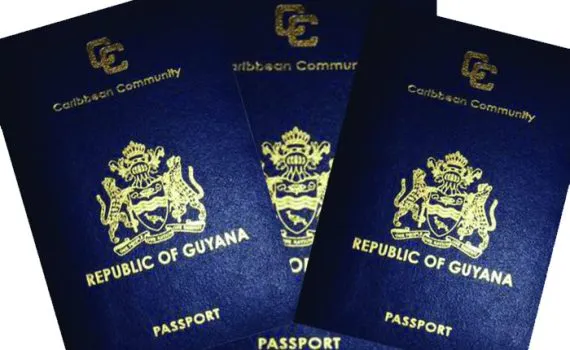
Photo: Guyanese passport dual citizenship documents Caribbean diaspora, via embassynvisa.com
Renata Singh has lived in Brooklyn for seventeen years. She owns a home in East Flatbush, has a daughter in her second year at CUNY, and hasn't set foot on Guyanese soil since her aunt's funeral in 2019. But ask her if she's given any thought to letting her Guyanese passport lapse, and she'll look at you like you suggested she sell her grandmother's gold bangles.
"That passport is mine," she says, leaning forward over her kitchen table. "My mother was born there. My grandparents are buried there. No amount of inconvenience is going to make me give that up."
For hundreds of thousands of Guyanese Americans scattered from South Florida to the Bronx to the Bay Area, citizenship isn't just a legal status. It's an identity anchor. But the longer you live in the US, the more complicated that anchor gets — and the more it costs to keep it.
The Paperwork Never Stops
Let's start with the practical reality, because it hits you first.
Guyanese passports are valid for ten years for adults, which sounds manageable until you factor in the process of renewing one from the United States. Depending on where you live, you're either driving to the Guyanese Consulate in New York or mailing documents across the country and hoping for the best. Processing times fluctuate. Fees add up. And if your name has changed — through marriage or otherwise — you're looking at a whole separate documentation trail.
Devanand Persaud, a truck driver based in Kissimmee, Florida, renewed his passport last year and describes the experience as "a part-time job I didn't apply for." Between gathering notarized documents, taking time off work, and making two separate trips to New York because his application came back with a minor error, he estimates the whole process cost him close to $800 when you factor in travel, lost wages, and fees.
"But I did it," he says. "Because I'm not giving it up."
That sentiment — stubborn, proud, deeply felt — runs through nearly every conversation about this topic in the diaspora. The hassle is real. The commitment is realer.
What Dual Citizenship Actually Means (And What It Doesn't)
Guyana formally recognizes dual citizenship, which means Guyanese Americans who've naturalized here don't have to choose. On paper, at least, you can be fully American and fully Guyanese at the same time.
But "on paper" is doing a lot of work in that sentence.
In practice, dual citizenship comes with a set of rights and restrictions that many diaspora members don't fully understand until they run into a wall. Guyanese citizens can own land in Guyana, which is a significant draw for anyone thinking about investing back home or retiring there one day. But the process of actually purchasing property as a non-resident citizen involves navigating a bureaucracy that moves at its own pace and rewards patience above all else.
Healthcare access is another factor that comes up repeatedly. Several people we spoke to mentioned that maintaining citizenship gives them a sense of security around medical care if they ever spend extended time in Guyana — whether for family obligations, retirement, or just a longer visit. "If something happens to me when I'm down there," says Marcia Greenidge, a nurse in the Bronx, "I want to be treated as a citizen, not a tourist."
Voting rights exist on paper too, though the logistics of voting from abroad remain a persistent frustration for diaspora members who care deeply about Guyanese politics — and many do.
The Emotional Ledger
Here's the part that doesn't show up in any fee schedule.
For many Guyanese Americans, especially those who came over as children or teenagers, the passport represents an unresolved question that never quite goes away: Is this really home, or is that? Keeping the Guyanese passport is, in some ways, a refusal to fully answer that question. It's a way of leaving the door open.
"I became a US citizen because I had to, for my career, for stability," says Marcus Fernandes, an IT manager in Atlanta who emigrated from Georgetown at age fourteen. "But the day I took that oath, I cried. Not because I was happy — I mean, I was — but because I felt like I was doing something to my Guyanese self. Like I was splitting in two."
He renewed his Guyanese passport six months later.
That split feeling is something therapists who work with immigrant communities recognize immediately. The passport becomes a transitional object — a tangible thing that holds intangible meaning. It says: I have not forgotten. I have not fully left.
For parents, the stakes feel even higher. Many diaspora members are adamant about registering their American-born children as Guyanese citizens, even when those kids have never visited and may have only a passing interest in the culture. "My son is twelve," says Renata. "He's never eaten cook-up from a pot in someone's yard. But he is Guyanese. And one day he'll understand why that matters."
The Financial Calculus
Let's be honest about something: maintaining Guyanese citizenship is not free, and for working-class diaspora families, the costs accumulate in ways that don't always get acknowledged.
Beyond passport renewal fees, there are the costs of staying legally connected to a country you don't live in. If you own property there, you have property taxes, maintenance, and the expense of managing it remotely — usually through a relative or a property manager you may or may not fully trust. If you're sending remittances, which a significant portion of the diaspora does, that's a regular financial outflow that comes before any personal savings goals.
And yet, for most people we spoke with, the question of whether it's "worth it" barely registers as a real question. Worth is the wrong frame entirely.
"It's like asking if it's worth it to remember your parents," says Marcia. "It's not a transaction. It's just who you are."
Holding On, Moving Forward
The Guyanese American experience has always been defined by this particular kind of doubleness — building a life here without dismantling the one that came before. The passport is the most literal expression of that duality, a small blue booklet that carries an enormous amount of weight.
For some, the costs — financial, logistical, emotional — will eventually tip the balance, and they'll let it lapse quietly, maybe with some guilt, maybe with relief. For others, renewing that passport every decade is as non-negotiable as calling home on Sunday.
What's clear is that citizenship, for the Guyanese diaspora, has never been just a legal category. It's a declaration. It's a promise made to a place and to the people left behind there. And for most of the community, no processing fee is high enough to make them break it.
Renata puts it simply, standing up to refill the kettle: "When I die, I want them to know I was Guyanese. That's it. That's the whole reason."
Some things, it turns out, aren't complicated at all.