"Pass Me the Dutchie" Is Not Guyanese Creole: A Love Letter to the Words We're Losing
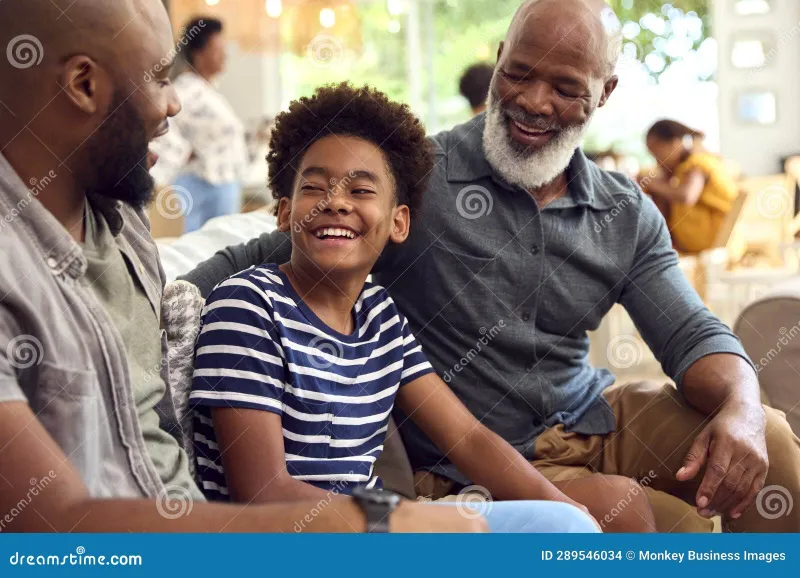
Photo: Guyanese family multi-generational gathering talking laughing at home, via thumbs.dreamstime.com
Let's set the scene. You're in the kitchen, Sunday morning, oil burning a little too hot, and you holler at your teenager: "Aye, come leh we cook!" They walk in, look at you, and say — in the flattest American accent you've ever heard — "What does that mean?"
And something in your chest does a little thing.
It's not quite heartbreak. It's more like watching a thread pull loose from something you didn't realize you were still wearing. For thousands of Guyanese parents raising kids in the US, that moment — the blank stare, the confused head tilt, the "huh?" — is becoming a familiar one.
Guyanese Creole is slipping through the generational cracks. And while it's easy to shrug it off as just the natural cost of immigration, linguists, parents, and a growing number of young Guyanese Americans are starting to push back on that idea.
What We're Actually Talking About
First, a quick clarification for the uninitiated — or for those who might need to explain this to their non-Guyanese friends: Guyanese Creole (also called Creolese) is not broken English. It is not slang. It is a fully developed contact language with its own grammar, syntax, vocabulary, and regional variation, shaped by centuries of African, South Asian, Indigenous, Dutch, and British influences.
It is, in other words, a linguistic fingerprint of Guyanese history. Every time someone says "wha' you deh pon?" or "she does talk too much" or "leh we go," they're speaking a language that carries an entire civilization inside it.
Which makes it worth protecting.
The Silence in Second-Generation Homes
The erosion typically follows a predictable pattern. First-generation Guyanese immigrants arrive in the US, often code-switching between Creole at home and Standard American English at work and school. Their children grow up hearing the language but speaking it less — and understanding it even less consistently. By the third generation, it's often reduced to a few phrases, a handful of food words, and maybe the ability to follow along at family gatherings if everyone speaks slowly.
Samantha Boodram, a 34-year-old Guyanese American living in Brooklyn, grew up in a household where her parents spoke Creole to each other but addressed the kids almost entirely in standard English.
"They wanted us to fit in," she says. "They thought speaking Creole at home would confuse us or hold us back. And I understand that — they were doing what they thought was best. But now I'm an adult and I feel like I missed something."
She describes attending family events in Guyana as an adult and feeling like she was watching a movie without subtitles. "Everyone around me was laughing and I'd catch maybe sixty percent of what was being said. That feeling of being on the outside of your own family — that stays with you."
It's Funny Until It Isn't
Let's be honest: some of this is genuinely hilarious. There's a whole genre of Guyanese diaspora humor built around the language gap — the kid who thought "gyaff" was a type of animal, the teenager who used "wutless" in a school essay, the American-born cousin who pronounced "bigan" like it was a proper noun.
Guyanese social media is full of this content, and it lands because it's relatable. The comedy comes from recognition.
But underneath the jokes, there's a real conversation about identity. Language isn't just a communication tool — it's a way of thinking, a way of categorizing the world, a way of belonging. When kids lose access to Creole, they lose more than vocabulary. They lose a particular way of seeing themselves in relation to their culture.
Dr. Marcia Henry, a linguistics researcher who has studied Caribbean Creole languages in diaspora communities, puts it plainly: "Language is one of the most intimate carriers of cultural identity. When a community stops transmitting its language, it doesn't just lose words — it loses entire frameworks for understanding experience."
What's Actually Working
Here's the good news: people are fighting for this, and some of them are winning.
Parents who've been intentional about Creole transmission tend to share a few common strategies. The first is consistency — speaking Creole at home without apology, even when kids respond in English. The second is context: connecting the language to food, to music, to stories, so it doesn't feel like homework but like a living thing.
Michael Dhanraj, a father of three in the Atlanta area, made a rule in his house that certain conversations only happen in Creole. "If you want to talk about what we're eating for dinner, you gotta try it in Creole. It became a game. Now my ten-year-old corrects my wife's pronunciation and thinks he's the big man."
On the digital side, something interesting is happening. Young Guyanese Americans — many of whom grew up with limited Creole exposure — are actively reclaiming the language online. TikTok accounts dedicated to teaching Creole phrases have racked up significant followings. YouTube series breaking down Guyanese dialect for second and third-generation diaspora kids are finding real audiences. Discord servers and Facebook groups have become informal language exchange communities.
It's not traditional language preservation. But it's working.
A Few Words Worth Saving
In the spirit of doing our part, here are a few Guyanese Creole expressions that deserve to survive the generational handoff:
- "Wha' you deh pon?" — What are you up to? (Versatile. Use it constantly.)
- "Gyaff" — A casual conversation, a chat. As in: *"we had a good gyaff."
- "Wutless" — Worthless, no-good. A classic.
- "Leh we" — Let's. As in: *"leh we go," "leh we eat."
- "Fuh true" — For real. Emphasis. Confirmation.
- "Banna" — Friend, buddy. Affectionate.
- "Old talk" — Reminiscing, nostalgia conversation. The best kind.
Teach your kids these. Use them at the dinner table. Text them to your nieces and nephews. Make them weird and funny and normal all at once.
The Language Is Still Here
Guyanese Creole isn't gone. It's alive in living rooms and church halls and WhatsApp voice notes and the comment sections of Guyanese Facebook groups. It's in the way your auntie laughs and the way your grandfather tells a story and the way certain feelings only make sense when you say them a particular way.
The question is whether the next generation gets to carry it forward — not as a museum piece, but as something they actually use, something that's actually theirs.
That starts at home. It starts with not switching to English the moment the kids walk in the room. It starts with letting them hear you, really hear you, in the fullest version of who you are.
Leh we not let this one go.