Don't Sweep at Night and Other Rules We Still Live By: Guyanese Superstitions in the American Home
There's a moment that almost every Guyanese American recognizes. You're in your apartment in Brooklyn or Queens or the Bronx, it's 9 PM, and you grab the broom to do a quick sweep before bed. Then it happens — your mother's voice hits you like a reflex. Don't sweep at night. You'll sweep away your luck. You put the broom down. You don't even question it.
That's the thing about superstitions. They don't ask for your belief. They just live in you, passed down through kitchens and back porches and late-night warnings from people who swore they'd seen the consequences firsthand.
For Guyanese families scattered across the United States, these folk beliefs arrived in the same suitcases as the saris, the curry powder, and the photographs. And somehow, through apartment moves and college degrees and American assimilation, a whole lot of them stuck.
The Rulebook Nobody Wrote Down
Ask any Guyanese household in the diaspora and you'll get a version of the same list. Don't sweep at night. Don't hand someone scissors directly — put them down and let the other person pick them up, or you'll have a falling out. Don't rock an empty chair. If your right hand itches, money is coming; if your left hand itches, money is leaving. Don't open an umbrella inside the house. Don't let a baby see its reflection in a mirror before a certain age.
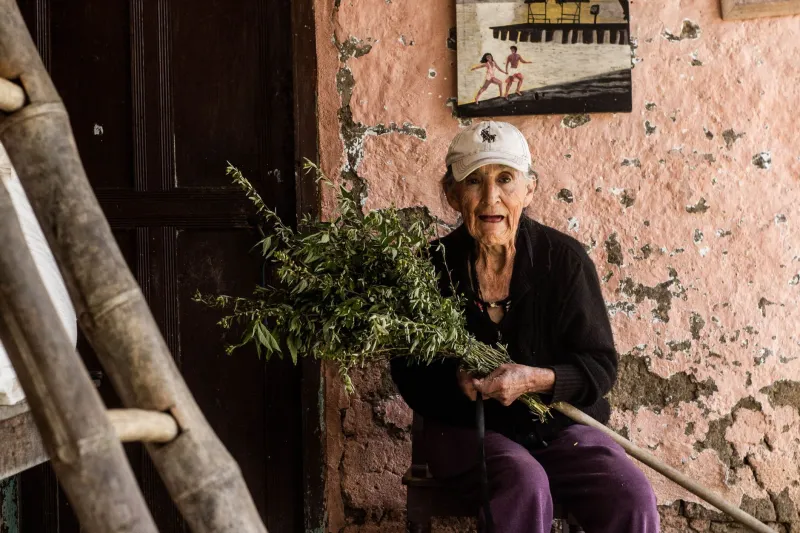
And then there are the more distinctly Guyanese ones — the ones that don't show up on any generic list. Keeping a small glass of water near the front door to catch bad spirits before they enter. Burning certain herbs to cleanse a home after conflict or illness. Saying a prayer before eating the first meal in a new house. Tying a red string around a baby's wrist to ward off the evil eye.
Nadine Persaud, 34, grew up in Richmond Hill, Queens — one of the most densely Guyanese neighborhoods in the United States. She laughs when she talks about it, but she's not laughing at the beliefs themselves. "My grandmother had rules for everything," she says. "You couldn't put a bag on the floor or your money would disappear. You couldn't wear shoes in the house — not just for cleanliness, but because you'd bring the outside energy in. I thought it was just old-people stuff until I moved into my own place and realized I was doing all of it automatically."
Why Do These Beliefs Travel So Well?
Psychologists and cultural anthropologists have long studied why immigrant communities hold onto folk traditions with such tenacity, often long after they've adapted in nearly every other way. The short answer: uncertainty.
When you uproot your life and plant it somewhere new, you lose a lot of the invisible scaffolding that made daily life feel manageable. The familiar sounds, the food, the language rhythms, the faces — they're gone or diluted. Superstitions offer a different kind of stability. They're a set of rules that feel like they work, even when the new country doesn't play by rules you understand yet.
For Guyanese immigrants who arrived in the 1970s, 80s, and 90s — many of them navigating a country that wasn't always welcoming — these beliefs weren't just comfort. They were a form of spiritual armor.
"My parents came here with almost nothing," says Marcus Rodrigues, 41, a second-generation Guyanese American from the Bronx whose family is of Afro-Guyanese descent. "They couldn't control a lot of what happened to them here. But they could control whether they swept at night. They could control whether they put that glass of water by the door. It gave them a sense of agency when they didn't have much."
The Generation That Inherited the Rules
What's fascinating about the Guyanese diaspora specifically is how these beliefs have survived into the second and even third generation. Kids who grew up fully American — born in New York or New Jersey or Florida, educated in American schools, fluent in internet culture — still catch themselves following rules their grandparents taught them.
Some embrace it openly. Priya Lall, 27, a third-generation Guyanese American from Berbice-rooted family in South Florida, has a whole TikTok series about growing up with Guyanese superstitions. "The comments are wild," she says. "Indo-Guyanese people, Afro-Guyanese people, mixed families — everybody recognizes the same stuff. Some of it overlaps with South Asian traditions, some of it overlaps with Afro-Caribbean traditions, and some of it is just Guyanese. It's its own thing."
Others are more conflicted. "I'm a pretty rational person," admits Kezia Thomas, 30, who works as a nurse in Atlanta. "I know there's no scientific basis for most of this. But I still won't rock an empty chair. I can't do it. My grandmother told me it invites a spirit to sit in it, and now every time I see an empty rocking chair move, I feel it in my chest. That's not logic. That's just deep programming."
When Superstition Becomes Ceremony
There's a meaningful distinction between superstitions that are about fear and ones that have evolved into something more like ritual — a way of marking time, honoring ancestry, and maintaining connection to a place most younger Guyanese Americans have never even lived in.
Burning incense or certain woods during specific occasions. Saying particular prayers before major life events. Keeping a small home altar with photographs of the deceased. These practices blur the line between superstition and spirituality, and in many Guyanese households, that line was never very clear to begin with.
"Back home, the spiritual and the everyday aren't really separate," explains Nadine. "You don't have 'regular life' and then 'spiritual life' on Sundays. It's all woven together. When my family brought those practices here, they brought that whole way of seeing the world. The superstitions are just the most visible part of it."
What Gets Kept, What Gets Left Behind
Not everything makes the cut across generations. The more elaborate rituals that require specific herbs, specific people, specific community knowledge — those are harder to maintain in diaspora. Some have faded simply because the knowledge holders are gone.
But the everyday rules? The ones that require nothing more than awareness and a bit of habit? Those travel beautifully. They cost nothing. They ask very little. And they carry a whole world inside them.
So the next time you're at a Guyanese American's apartment and you reach for the broom at 10 PM, don't be surprised if someone stops you. It's not superstition, they'll probably tell you with a grin. It's just how we do things.
And honestly? After all the miles and all the years, maybe that's enough of a reason.